Though details are scant, California artist and educator Benny Barrios, considered Sacramento’s pioneering Mexican American painter, took a group of adult students to Jocotepec in 1967 for an art workshop.
Benjamin ‘Benny’ Barrios was born in Bixby, Arizona on 20 March 1925 and spent his childhood in Clovis. His parents were from the town of Yahualica, near Guadalajara. He worked in the fields, attended schools in Sacramento, served as an Army Air Corps mechanic during World War II, nearly became a professional boxer, and studied art at the Choinard Institute in Los Angeles.
He exhibited at the California Watercolor Society (1952, 1953) and then in 1954 became the first Latino to have an exhibit at the Crocker Art Museum, where he showed a series called “Wetbacks” depicting the plight of farm worker migrants. His show called “Pssst” at the same museum a decade later depicted the seamier side of street life. Many of his paintings are of Sacramento buildings and scenes that no longer exist.
His works have also been shown at the Los Angeles County Art Museum, the California State Fair, the De Young Museum in San Francisco, and the Oakland Art Museum. Miguel Alemán, president of Mexico from 1946-1952, also owned one of his paintings.
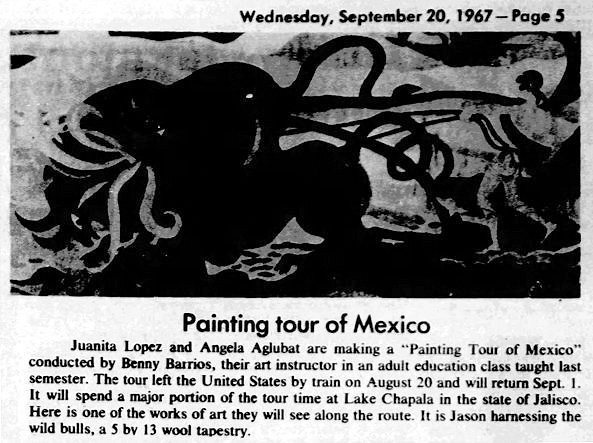
The East Yolo Record, 20 Sep 1967, p5.
In 1959 he opened his own gallery in Sacramento and taught adult education classes in the city. He led at least one workshop “for 26 women students” in Jocotepec in August 1967. They traveled from the U.S. by train and visited Guadalajara briefly before working for about a week in Jocotepec. Paintings by his students were displayed in the Sacramento Courthouse (8th and H streets) later that year. Are any of these paintings still in existence? If so, please get in touch!
Several students of Barrios subsequently had their own art careers, including Virginia Chittick, a Californian artist who studied in Europe and at Los Angeles College, who had a solo show of landscapes, seascapes and still life works in Guadalajara at the Instituto Cultural Mexicano Norteamericano de Jalisco A.C. in 1972.
Sources
- The East Yolo Record: 20 Sep 1967, 5.
- The Sacramento Bee: 22 Oct 1967, 112; 6 Aug 1999, 99; 29 Apr 2001, 241; 8 Jul 2011, X31.
- El Informador: 30 Oct 1972, 9; 1 Nov 1972, 30.
- The Fresno Bee: 1 Oct 1972, 86.
Comments, corrections and additional material are welcome, whether via comments or email.
Tony Burton’s books include “Lake Chapala: A Postcard History” (2022), “Foreign Footprints in Ajijic” (2022), “If Walls Could Talk: Chapala’s historic buildings and their former occupants” (2020), (available in translation as “Si Las Paredes Hablaran”), “Mexican Kaleidoscope” (2016), and “Lake Chapala Through the Ages” (2008).