I might never have stumbled across John Wadleigh’s novel The Bitter Passion (1959), were it not for a review by Tom Ray, who said that he had been told by a friend in Mexico: “that some of the Norte-Americano expatriates had been asked to leave the Lake Chapala area. This sensitive, well-written novel deals with such a colony (perhaps with the one mentioned), and the inevitable tragedy derived from the behavior of rootless people who have drunk too much and have too little to do.”
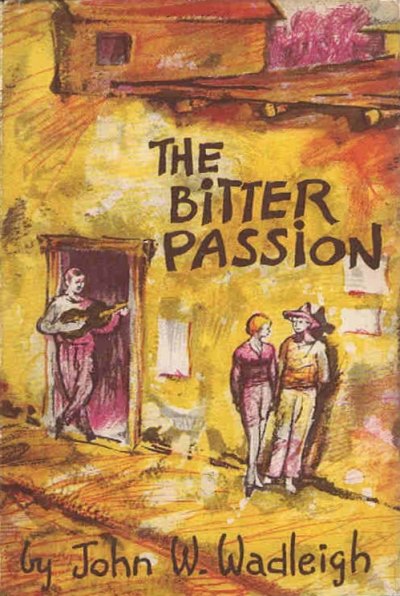
There was something about this review which suggested that Ray had inside information about the book. So, curiosity piqued, I looked into the author and read the novel for myself.
Author and artist John Warren Wadleigh was born on 14 December 1927 in New York City. After serving in the U.S. military from 1945 to 1951, he graduated from Columbia University, and began writing while making money at a number of different jobs, including as an editorial assistant at The New Yorker.
Wadleigh married Judith Ferree (1929-1994) on 11 April 1954 at Westport, Connecticut, and published his first novel The Bitter Passion in 1959. The back cover blurb explains that the author, married with two children, had worked—at one time or other—as a station engineer, radio operator, veterinarian’s assistant, factory worker, soldier, publicity writer, editorial assistant and telephone linesman. After living for six years in Europe and Mexico, he had returned to live in New York City.
Wadleigh’s debut novel—“a first novel of deceptive simplicity”—is the “tragic story of an emotional explosion in the primitive Mexican fishing village of Oxahuitcoatl.” The basis for the fictional village of Oxahuitcoatl was Ajijic; many elements in the novel are a near-perfect match for the lakeside village, where Wadleigh must had lived long enough at some point to fathom out the shifting social undercurrents stirred by an ever-increasing number of American residents.
Infuriatingly, I can’t find any direct corroborating evidence to confirm that Wadleigh did actually live in Ajijic or anything about the timing and circumstances of his visit or visits to Mexico.
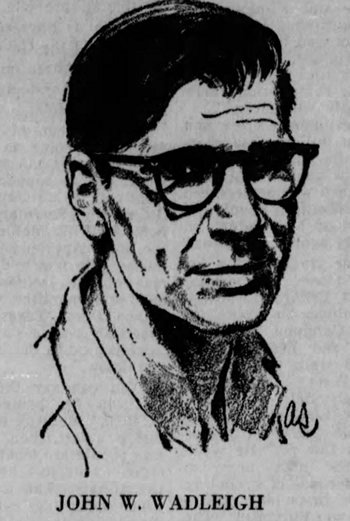
Credit: St. Louis Post-Dispatch: 19 April 1959, p35.
A future post will look more closely at the novel. But shortly after its publication, Wadleigh moved to Santa Fe, New Mexico. While his reasons are unclear, perhaps he was yearning to distance himself from the bright lights and telephones of the big city for a lifestyle more akin to what he’d experienced in Ajijic.
In Santa Fe, Wadleigh enjoyed painting and sculpting and won an honorable mention for sculpture at the 1965 Fiesta Biennial Exhibition at the Museum of New Mexico. In the early 1960s, Wadleigh joined with Oliver LaFarge and Spud Johnson to found the (original) Pasatiempo arts magazine in Santa Fe, to which he contributed as an art critic.
Following the success of his first novel, Wadleigh published another dozen novels, using the pseudonym Oliver Lange. They included the widely acclaimed Vandenberg (1971)—where the eponymous hero and his friends, living in the New Mexico wilderness, resist a Soviet invasion of the US—Red Snow ((978), Next of Kin (1980), Land of the Long Shadow (1981), Pas de Deux (1982), The Devil at Home (1986) and Making It (1989).
In the 1980s, Wadleigh moved to Friday Harbor, Washington, and then to Bandon, Oregon, where he died on 24 September 2013 at the age of 85.
Sources
- Tom Ray. 1959. “The Bitter Passion” (review). San Francisco Chronicle, 31 May 1959, 68.
- Oliver Lange (John W Wadsley). 1971. Vandenberg. Stein & Day.
- John W Wadleigh. 1959. The Bitter Passion. E.P. Dutton.
- Albuquerque Journal: 2 Jul 1965, 15.
- The Atlanta Journal: 7 Jun 1959, 83.
- New York Times: 6 July 1959, 22.
- Robert Nott. 2013. “John Wadleigh, 1927–2013: Artist, writer, critic was a ‘big character’.” Santa Fe New Mexican. 2 Oct 2013.
Comments, corrections and additional material are welcome, whether via comments or email.

Tony Burton’s books include “Lake Chapala: A Postcard History” (2022), “Foreign Footprints in Ajijic” (2022), “If Walls Could Talk: Chapala’s historic buildings and their former occupants” (2020), (available in translation as “Si Las Paredes Hablaran”), “Mexican Kaleidoscope” (2016), and “Lake Chapala Through the Ages” (2008).
wow! you have me curious— Hope to see your follow up and wish I could fit reading a few of his works into my schedule.
Patience will be required, Bill . . . I’ve only skimmed the novel so far, and have to read it properly before sharing my thoughts in print! Have a wonderful Christmas, Tony.