The earliest set of real photo postcards of Ajijic is that produced and sold by Robert ‘Bob’ Bassing (1925-2024), who lived there from 1951 to 1954, with his wife, novelist Eileen Bassing (1918-1977), the author of “Where’s Annie?” a novel set in Ajijic. The family lived in a $5 a month home in Ajijic, and supplemented their income by selling home-made fudge and operating a small shop and lending library named “Simple Pleasures.”
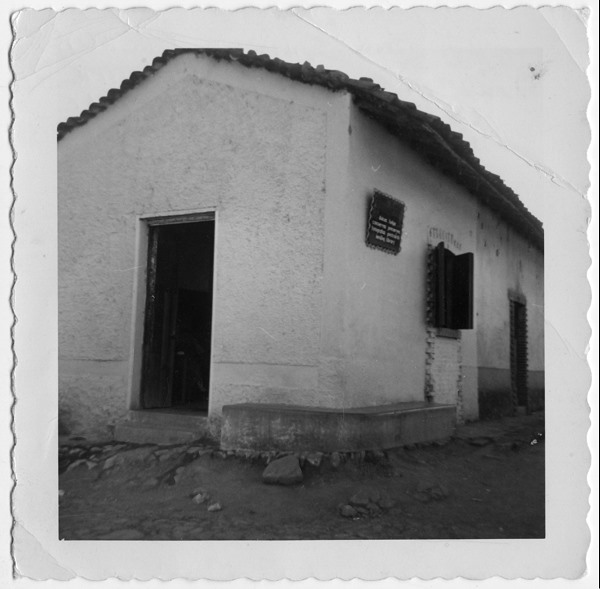
“Simple Pleasures,” c 1953. Photo by Bob Bassing.
Simple Pleasures was initially located at the northeast corner of the intersection of calles Ramón Corona and Constitución, but soon moved to the southwest corner (pictured).
The northwest corner of that same intersection was where, from 1950 to 1952, black American artist Ernest Alexander (‘Alex’) ran Bar Alacrán (Scorpion Club), a hang-out of choice for Ajijic’s resident artists and writers of the time, including David Morris and his wife, Helen, sculptors Robert McChesney and his wife, Mary Fuller. It is also where ethnomusicologist Sam Eskin recorded a religious festival in Ajijic, complete with church bells and pre-dawn firecrackers, for Mexican firecrackers: a prayer and a festival.
The hand-painted sign for Simple Pleasures, painted by Nicolas Muzenic, an American artist who lived in Ajijic and taught summer art classes there, may be the first English-only sign in Ajijic, a portent of things to come. The sign read:
- Homemade Fudge
- Preserves
- Lending Library
- Photographic Postcards
After the Bassings returned to California, the building became a bar named La Raspa. When a man nicknamed “El Muca” was killed during a street fight outside the bar, bystanders placed his body on the low cement wall outside the bar, which led to the wall subsequently being referred to as “el muca’s bed.” Later, the building was used for the Megikari healing center with temazcales (sweat lodges), run by Salvador Robledo Chacón. (My thanks to Ajijic artists Antonio López Vega, Jesús Victoriano López Vega and Dionicio Morales for this information.)
The photographic postcards sold in Simple Pleasures were all printed from photographs taken by Bob Bassing. When I chatted to him about the cards (shortly before he died in 2024), his one regret was that he hadn’t added any credit or advertising on them. The series comprised about a dozen images, almost all of which have a white border around them. The postcards have no captions, dates or photographic credit, and this series would have passed unrecorded were it not for a chance remark Bob made when we were talking about his life in Ajijic in the early 1950s.
Here are a few examples of the postcards:
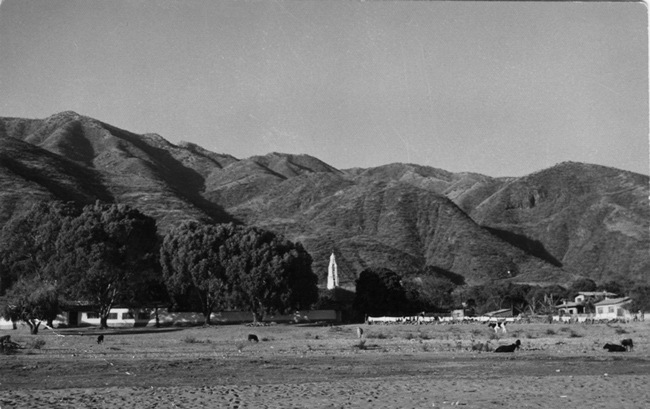
Postcard (borderless) of Ajijic, c. 1953. Photo: Bob Bassing.
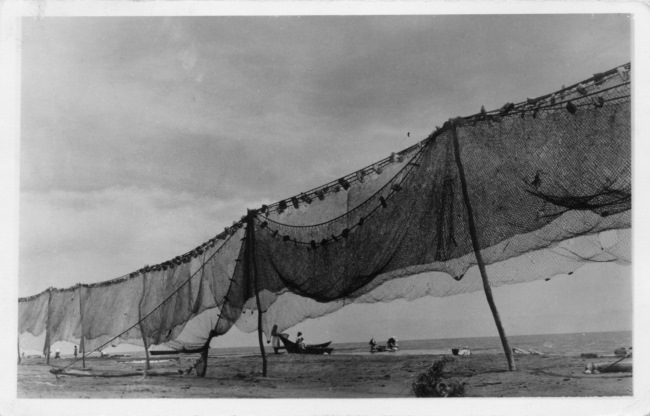
Postcard of Ajijic, c. 1953. Photo: Bob Bassing.
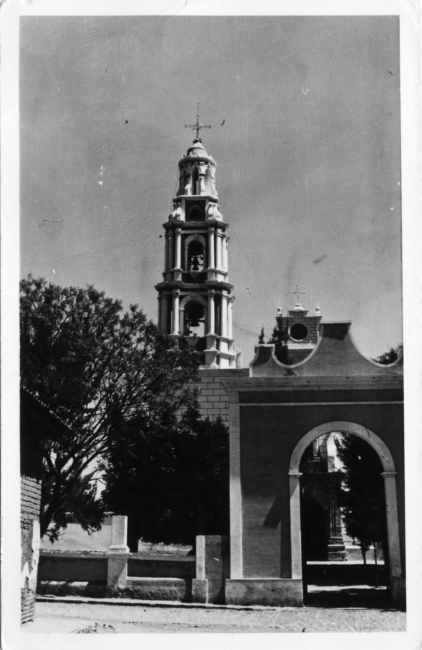
Postcard of Ajijic, c. 1953. Photo: Bob Bassing.
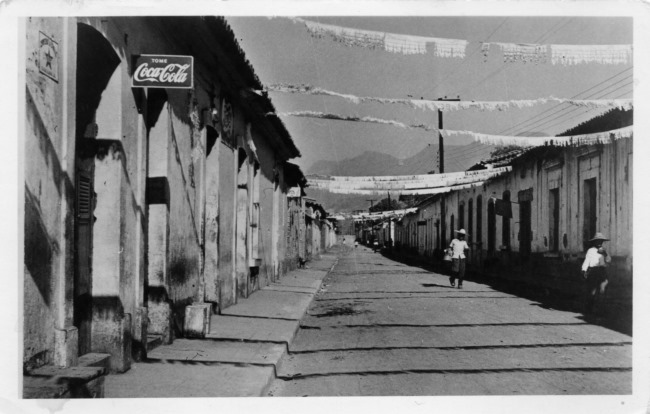
Postcard of Ajijic, c. 1953. Photo: Bob Bassing.
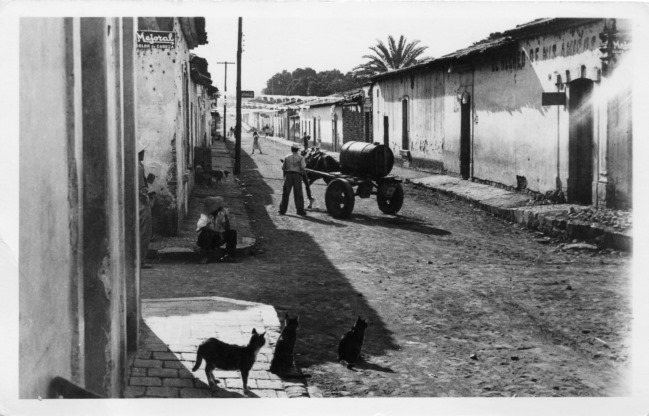
Postcard of Ajijic, c. 1953. Photo: Bob Bassing.
Acknowledgment
My sincere thanks to the late Bob Bassing for many edifying phone conversations about his time in Ajijic, and for his generous donation of numerous real photo postcards he produced.
Sources
- The Marion Star, Ohio, 10 March 1957, p 18.
Comments, corrections and additional material welcome, whether via comments feature or email.

Tony Burton’s books include “Lake Chapala: A Postcard History” (2022), “Foreign Footprints in Ajijic” (2022), “If Walls Could Talk: Chapala’s historic buildings and their former occupants” (2020), (available in translation as “Si Las Paredes Hablaran”), “Mexican Kaleidoscope” (2016), and “Lake Chapala Through the Ages” (2008).
Oh wow! what research— NOw, i relate an odd observation and memory from the Jungles of Yucatan in 1971–and there was not modern development. Somehow, I was deep in the jungle with some American workers, the kind of guys that would have been outlaws or sheriffs a 100 years earlier. I’m a kid and listening to these guys and I will always recall one of them says, “I don’t care how deep you go in the jungle here or the Amazon you will find coke bottle.” And what do I see in these postcards but the ever familiar Coca-Cola sign. Thanks again–great discovery.
Ah yes, the ubiquitous Coca-Cola! While not relevant to Chapala, you might like this photo I took in about 1993 in Monterrey . . . Un abrazo, amigo.