Artist and sculptor Violet Wilkes lived for about twenty years in retirement in Chapala with her husband, John, beginning in the early 1960s.
Violet (‘Vi’) Wilkes (née Macintyre) was born on 1 November 1894 in Glasgow, Scotland. For reasons unknown, she crossed the Atlantic in 1911 to be raised by an aunt and uncle in Jennings, Louisiana. Violet subsequently became a permanent U.S. resident, and took a position as a stenographer at the British Embassy in Washington D.C.
In April 1935, Violet married John Buckner Wilkes in Jennings. The newly-weds then settled in Baltimore. In December 1937, Violet was home alone in their third floor apartment when a major fire broke out on a lower floor. She was totally trapped, and could only watch from a window as firemen rescued several other people while they waited for a bigger fire engine to arrive with a long enough ladder to reach her. A photo of her dramatic rescue was splashed across the front page of a local paper the following day. Violet escaped, but all their belongings and furniture were damaged or destroyed.
The following year (1938) Violet visited Mexico, though the purpose of this visit, and whether or not she was accompanied by her husband, remains unclear.
Violet, who loved ballet as a child, took classes in ceramics at the Maryland Institute in Baltimore and began to make small ceramic figurines. The Baltimore Sun, reporting on a solo exhibition of her work in 1947 at the Enoch Pratt Free Library in Baltimore, highlighted her creativity in crafting original and innovative ‘dancing dolls’ which—despite having no springs, wheels or mechanism—walked, twirled or danced in response to the slightest vibration. By then she had made more than 100 ‘vibro-dancers,’ most about 15cm (6″) tall, including dancers, skaters and classical ballerinas, representing almost every nation in the world, from Chinese figures in imperial attire to Scotsmen in tartan kilts doing the Highland Fling. Some of her figures had been exhibited previously at the Pittsburgh Dolls Club.
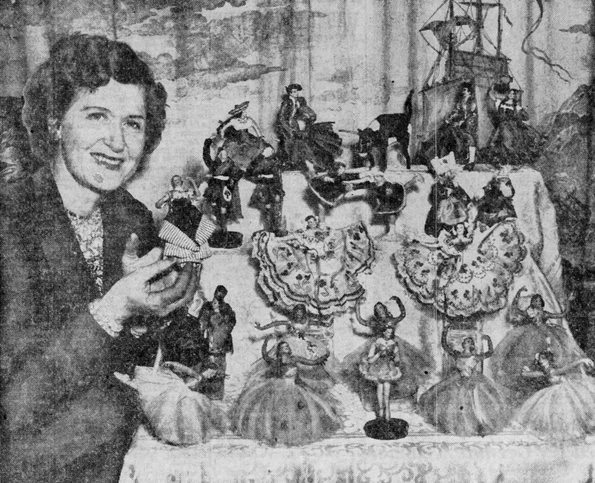
Violet MacIntyre Wilkes. Credit: The Baltimore Sun, 17 December 1949, p10.
The vibro-dancers, balanced on bristles and with wire for a frame, took up to a week to make. With bodies sculpted of plastic wood, and ceramic heads with delicately painted faces and silk hair, they were adorned with tiny jewelry (as small as a pinhead) and hand painted fabric, all matching the scale of the dolls. Some of these dolls literally balanced on a single toe! There was even one of an agile toreador with red cape fighting a beguiling bull. By 1949, when Violet showed her dolls at the Art Institute in Zanesville, Ohio, she was making and shipping dolls all over the U.S., though she was tired of that enterprise and anxious to move on.
Violet held several other solo shows in Baltimore in the 1950s, while simultaneously becoming President of the Baltimore Branch of the National League of American PEN Women. That group organized numerous juried art shows and annual Christmas shows at the Peale Museum in Baltimore. Violet had works accepted almost every year; in 1952 and 1953, her paintings and sculptures were shown alongside works by De Nyse Turner, another artist with a close connection to Lake Chapala.
In the early 1960s, Violet also exhibited at the Water Color Club and at the Vagabond Theater in Baltimore.
In about 1963, Violet Wilkes retired to Chapala with her husband, John B. Wilkes (1894-1979), who had worked forty years for the Baltimore Ohio Railroad.
The earliest press report of them in Chapala comes from June 1964. According to the Guadalajara Reporter, “Jack and Vi Wilkes (she’s a professional artist) … [had] supervised the redecoration of the Little Chapel by the Lake making it a most attractive place for the services of the Interdenominational group every Sunday.”
The following year, after her aunt Margaret Ritchie died in Jennings, Louisiana, Violet and her husband traveled north to help settle the estate. She had given Margaret dozens of her paintings, sculptures and ceramics over the years, and arranged for them to be exhibited (and some offered for sale) at the Jeff Davis Bank.
In 1966, Jack and Vi Wilkes moved into a renovated home in Chapala (at Avenida Estación #89). Later that year, she was the first artist to be offered the chance to exhibit her oils and watercolors at the Allen W Lloyd offices in Guadalajara (then located at Avenida 16 de Septiembre #420).
Violet’s last recorded exhibition was in February 1974, when she and three other artists—Jean Caragonne, Jane Porter and Allen Foster—showed works at La Galeria del Lago in Ajijic.
Violet’s husband, John, died in a hospital in Guadalajara on 28 April 1979. Unfortunately, at the time this occurred, Violet herself was in a Guadalajara hospital. Nothing more is currently known about the remainder of her life.
Sources
- The Baltimore Sun: 10 Dec 1937, 1; 27 Jun 1947, 16; 9 Jun 1947, A-5; 4 Mar 1948, 16; 8 May 1949, 12; 17 Dec 1949, 10; 12 Dec 1953, 16; 23 Apr 1959, 14; 22 Jan 1961, 32; 9 Apr 1961, 42; 10 Jun 1979, 11.
- The Evening Sun (Baltimore): 13 May 1949, 38; 23 Feb 1954, 11.
- Guadalajara Reporter: 11 June 1964; 23 Dec 1965; 12 Mar 1966; 6 Feb 1971; 3 April 1971; 2 Feb 1974.
- Lake Charles American-Press: 1 Dec 1965, 5.
- Jennings Daily News: 16 Dec 1937, 1.
- The Zanesville Signal: 6 Jan 1949, 19.
Comments, corrections and additional material welcome, whether via comments or email.