Aug 042014
 

Charles Bernard Nordhoff (1887-1947), best known as co-author of Mutiny on the Bounty, has several connections to Mexico, having spent his childhood, and learned to hunt, sail and fish, on  his family’s ranch near Todos Santos in Baja California. Having gained an undergraduate degree, he returned to Mexico, to work as a supervisor on a sugar plantation in Veracruz and fell in love with the plantation owner’s beautiful daughter. He visited the Chapala area in November 1909, writing up his bird-watching notes more than a decade later for Condor Magazine:

“The fresh water marshes of Lake Chapala, in the state of Jalisco, Mexico, form another haven for waterfowl. At one end of the lake there is a great area of flooded land cut by a veritable labyrinth of sluggish channels, 400 square miles, I should say. The far interior of this swampy paradise, reached after three days’ travel in a native canoe, is a vast sanctuary for wildfowl, a region of gently rolling damp prairies, set with small ponds, and traversed by a network of navigable channels leading to the great lake. I saw as many geese, White-fronted (Anser albifrons) and Snow (Chen hyperboreus), as I have ever seen in the Sacramento Valley, and the number of ducks was past belief, with some interesting species like the Masked and Florida Black or Dusky, to lend variety.”

Nordhoff was born in London, England, to well-to-do American parents.The family moved to Berlin, where his mother wrote in the family diary that, “Charlie undoubtedly began his study of water fowl, as his daily outing in a small pram or push cart led him first to the bakeries for a supply of stale buns and back to the lake to feed the ducks.” Following several years living on the ranch near Todos Santos, the family moved to California. Following in the footsteps of his grandfather, a journalist and author, Nordhoff wrote his first article, for publication in an ornithological journal, at age fifteen.
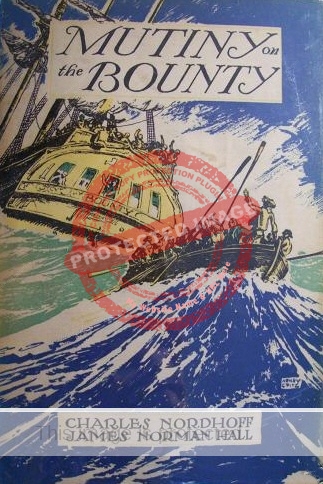
MutinyOnTheBountyHe studied briefly at Stanford University, but left in the aftermath of the serious earthquake and fire of 1906. After completing a B.A. at Harvard University in 1909, he returned to Mexico, to work on a sugar plantation in Veracruz. Unable to win the heart of the plantation owner’s beautiful daughter, with whom he had fallen in love, and with the Mexican Revolution breaking out around him, Nordhoff left Mexico in 1911, and never returned.

In 1917, Nordhoff joined the French Foreign Legion as a pilot, eventually winning the Croix de Guerre for his efforts. After the war, he wrote a history of the Lafayette Flying Corps. with James Norman Hall (who later updated the long-established and classic traveler’s guide to Mexico  Terry’s Guide to Mexico). The two men later moved to Tahiti to write travel articles for Harper’s, where Nordhoff married a Polynesian woman, Pepe Teara; they had six children.

In the 1920s Nordhoff wrote three novels. Picarò (1924) was based on his flying experience and life in Paris; The Pearl Lagoon (1924) and The Derelict (1928) were both semi-autobiographical. However, Nordhoff is best known for his collaboration with Hall on the Mutiny on the Bounty trilogy about the famous 1789 mutiny in the South Seas. The novel was the basis for three movie versions, the first of which, released in 1935, won an Oscar for Best Picture.

Nordhoff and Hall published six more co-authored novels, several of which were made into movies, but none came close to emulating the success of Mutiny on the Bounty. Tragically, following severe depression and heavy drinking, Nordhoff took his own life on April 10, 1947.

Lake Chapala Artists & Authors is reader-supported. Purchases made via links on our site may, at no cost to you, earn us an affiliate commission. Learn more.

This is a lightly edited extract from my Lake Chapala Through the Ages, an Anthology of Travelers’ Tales (Sombrero Books, 2008)

Comments, corrections or additional material related to any of the writers and artists featured in our series of mini-bios are welcomed. Please use the comments feature at the bottom of individual posts, or email us.
May 162014
 

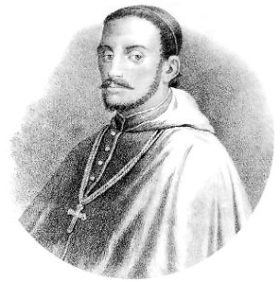
The earliest known reference to Lake Chapala in a poem must surely be that made by Bernardo de Balbuena (1562-1627) in El Bernardo, written between 1592 and 1602, published in Madrid in 1624. The poem took a decade to write because of its extraordinary length—some 40,000 octavo reales (Royal eighths) in size!

Balbuena was born in Valdepeñas, Spain, in 1562. In 1584, at age 22, he crossed the Atlantic to join his father, who owned properties in New Spain. This was only 63 years after the conquest, but already various cities had been founded and were beginning to prosper.
Balbuena was already a prizewinning poet by the time he was named Chaplain of the Audiencia of Guadalajara in 1592. He later lived for several years in the small isolated village of San Pedro Lagunillas near Compostela, close to Tepic. In 1593, he wrote Grandeza mexicana, a poem which appeared in book form in 1604, and was dedicated to Doña Isabel de Tobar y Guzmán, with whom he was in love.

Balbuena returned to Spain in 1606 and was never to set foot again in New Spain, despite having fallen in love with the country and having become a “Mexican” poet. In 1608, he published Siglo de Oro en las selvas de Erífile, a pastoral novel. In 1626, he became Bishop of Puerto Rico, dying there the following year.

In El Bernardo, the author begins by describing France and Spain. By Book XIII, he is describing Asia. Then (Book XV), he overflies Europe. The descriptions of imagined aerial trips are supposedly the best passages of the entire work, with the highlight being Book XVIII which sees the magician Malgesí flying over America, from Patagonia in the south to the northern edge of New Spain.

Numerous places are mentioned, including the Andes, Brazil and Chiapas, as well as Zacatecas, Guadalajara and the erupting volcano of Jala, before Chapala gets its moment of fame:

Come, between the fresh Pánuco and Gualulco
to Tlaxcala, and the Mexican kingdom,
to Michoacán, Colima and Acapulco
the town closest to the southern sea,
the villages of Quiseo and Tlajomulco,
and in their environs and flower-filled plain
the abundant lagoon of Chapala,
which equals the Ocean in depth and breadth.

Spanish-Mexican philosopher Ramón Xirau describes Balbuena as a “splendid poet who should be remembered and, above all, re-read.” However, reading (or re-reading) 40,000 octavo reales might well be more than most people have time for!

Lake Chapala Artists & Authors is reader-supported. Purchases made via links on our site may, at no cost to you, earn us an affiliate commission. Learn more.

[Extract from “Lake Chapala—as large as an ocean?”, chapter 7 of Lake Chapala Through the Ages: an anthology of travellers’ tales]

Jan 312010
 

It is impossible to do justice in these few lines to the brilliance of Friedrich Heinrich Alexander von Humboldt, aptly described by Charles Darwin as “the greatest scientific traveler who ever lived”. He was born in Berlin, Prussia, in 1769 to a very well-connected family.

He studied political economy before turning to science at the University of Göttingen in 1789. One of his friends there, George Forster, had been scientific illustrator on Captain James Cook’s second voyage. This friendship undoubtedly reinforced Humboldt’s determination to undertake his own long distance travels. Humboldt systematically prepared himself for a life as a scientific explorer, first studying commerce and foreign languages at Hamburg, then geology and mining at Freiberg, followed by anatomy at Jena, as well as astronomy and the use of scientific instruments.

Humboldt spent five years in the New World, from 1799 to 1804. His visit to Mexico began in Acapulco on March 22, 1803, and lasted until he set sail from Veracruz for the United States on March 7, 1804. In the intervening months, Humboldt measured, recorded, observed and wrote about anything and everything, with remarkable industry and accuracy. He climbed mountains, burned his boots on active volcanoes, descended into mines, recorded geographical coordinates, and collected specimens and antiquities. He also drew a large number of maps, drawings and sketches. Humboldt’s Political essay on the kingdom of New Spain was the first systematic scientific description of the New World. It appeared in 1811, and marked the birth of modern geography in Mexico. His figures and ideas were used and quoted by writers for many many years.

On his return to Europe, he spent more than twenty years, mainly in Paris, writing and publishing his results. The crowning glory of Humboldt’s career was his five-volume Cosmos. Begun at age 76, it turned out to be a masterpiece, proposing conceptual generalizations, supported by the observations of the physical world he had made decades earlier.

Humboldt’s work was the foundation for the subsequent development of physical geography and meteorology. Developing the concept of isotherms allowed climatic comparisons to be made. He recognized that altitudinal differences in climate echoed latitudinal differences. His essay on the geography of plants related the distribution of plant forms to varying physical conditions. Finding that volcanoes fell naturally into linear groups, Humboldt argued that these presumably corresponded with vast subterranean fissures. In addition, he demonstrated the igneous origin of volcanic rocks for the first time.

Humboldt’s work awakened considerable European interest in the Americas and caused many later artists to travel to Mexico to draw and paint.

Humboldt died, at the age of 89, on May 6, 1859. His travels, experiments, and knowledge had transformed western science in the 19th century. Humanist, naturalist, botanist, geographer, geologist: Humboldt was all of these, and more.

Lake Chapala Artists & Authors is reader-supported. Purchases made via links on our site may, at no cost to you, earn us an affiliate commission. Learn more.

A brief excerpt from Humboldt’s “Political Essay on the Kingdom of New Spain” is included in Tony Burton’s “Lake Chapala Through the Ages, an anthology of travelers’ tales” (Sombrero Books 2008).  This book has excerpts from more than 50 original sources covering the period 1530–1910, together with short biographies of the writers, and an informative commentary setting the extracts in their historical context.

Jan 032010
 

Charles Fleming Embree was born in Princeton, Indiana, October 1, 1874, the son of lawyer David Franklin Embree, member of a prominent pioneer family, and Mary Fleming Embree. Charles was still an infant when his father died in 1877. To this day, one of the main streets in Princeton is N. Embree Street, and the Fire Department Chief at the fire hall (on Embree and W. Brumfield) has the surname Embree.

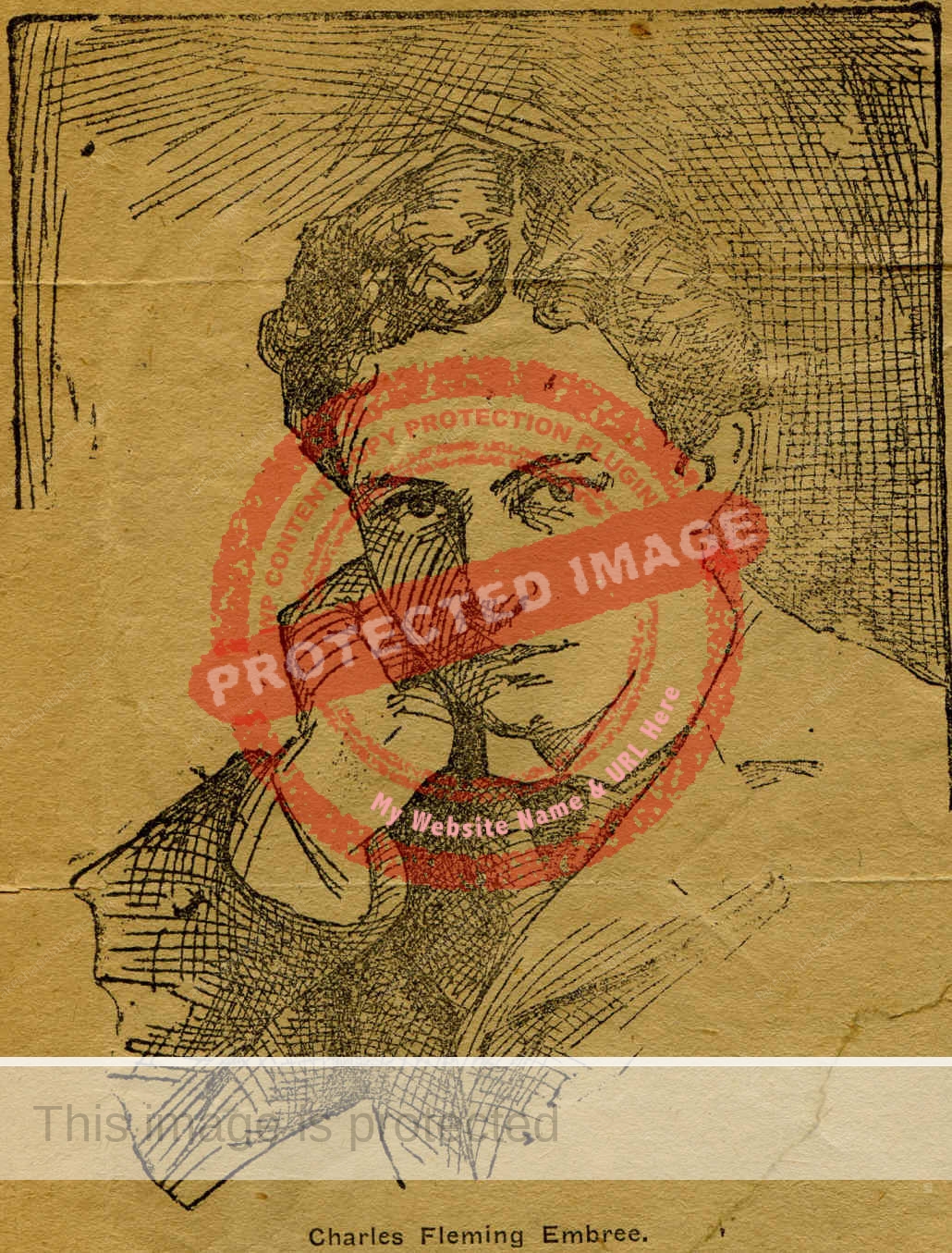
embree-portrait-2Charles Embree was educated in Princeton public schools and entered Wabash College in the fall of 1892. After three years he left college without graduating to devote himself to writing, and achieved immediate success. For the Love of Tonita, and other tales of the Mesas was his first book, published in 1897. The success of his first book led to two more novels.

On January 18, 1898, he married Virginia Broadwell. The young couple moved to Mexico, and lived in Chapala for eight months in 1898, before moving to Oaxaca. The precise motives behind Embree’s decision to spend two years in Mexico remain frustratingly unclear.

Embree’s second book, dedicated to his wife, is set in the Lake Chapala region, but was written while they were in Oaxaca. A Dream of a Throne, the Story of a Mexican Revolt (1900), is illustrated with five black and white drawings by Henry Sandham (1842-1910), a very well-known Canadian illustrator of the time. From Oaxaca, Embree also penned a short newspaper piece about anthropologist Frederick Starr, who was conducting fieldwork there.

Embree’s third book, illustrated by Dan Smith, was A Heart of Flame: the Story of a Master Passion (1901). Embree also had several short stories published in McClure’s Magazine, from 1902 to (posthumously) 1906. In recognition of the distinguished place he had already achieved among American novelists, Embree was awarded an honorary Master of Arts degree by Wabash College in 1903.

Embree and his wife moved to Santa Ana, California. Sadly, the couple had not long celebrated the birth of their only daughter Elinor in 1905 when Embree was taken seriously ill. He died on July 3, not yet 31 years old.

Lake Chapala Artists & Authors is reader-supported. Purchases made via links on our site may, at no cost to you, earn us an affiliate commission. Learn more.

A short extract from Embree’s A Dream of a Throne is included in my “Lake Chapala Through the Ages, an anthology of travellers’ tales” (Sombrero Books 2008). This book has extracts from more than 50 original sources covering the period 1530-1910, together with short biographies of the writers, and an informative commentary setting the extracts in their historical context.

Other twentieth century novels set largely, or entirely, at Lake Chapala include:

Comments, corrections or additional material related to any of the writers and artists featured in our series of mini-bios are welcome. Please use the comments feature at the bottom of individual posts, or email us.