Painter, sculptor and muralist Jose Maria de Servín, born in 1917 in La Piedad, Michoacán, was only a few months old when his family moved to Guadalajara. Despite Servín never living at Lake Chapala (certainly not for any length of time), he is profiled here because at least two of his mural works still survive in Chapala.
As a young man, Servín studied art in Guadalajara at the studio of José Vizcarra and at the Escuela de Pintura al Aire Libre. He became a member of a group of young artists known as the Pintores Jóvenes de Jalisco. In addition to assisting José Clemente Orozco on murals painted in the Palacio Legislativo de Guadalajara, Servin taught art at the University of Arizona summer program in Guadalajara for 15 years. In the course of his career, Servin experimented with many different techniques, materials and styles.
His first major exhibit was in 1940 at the Ateneo Español in Guadalajara. His talents were quickly recognized internationally, and only three years later, a show of his gouaches was held in The San Francisco Museum of Art.
His earliest known link to Lake Chapala was in 1948 when he was one of the artists exhibiting work in the 3rd Annual Painting Exhibition, held at the Villa Montecarlo in Chapala, from 21 August to 1 September. Other exhibitors on that occasion included Rubén Mora Gálvez, Tom Coffeen, F. Martinez Lois (or Lols?); Dolores de la Mora; A. Navarro España; Sterling Poindexter; E. Linares (Ernesto Butterlin) and Ruth Dunn.
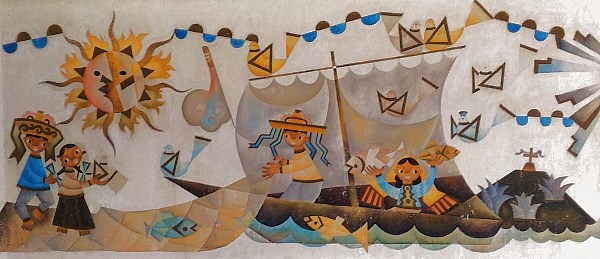
José María de Servin. c. 1960. Detail from Chapala Yacht Club mural. Photo: Tony Burton, 2020.
Servín subsequently painted two murals in Chapala: the first, depicting indigenous people working the land and fishing, was painted in 1950 in the dining room of the Villa Ferrara and the second, a decade later, in the Chapala Yacht Club.
In 1950, a year after his first solo show in Mexico City at the Galería de Arte Contemporáneo, Servín was commissioned to paint a mural (of indigenous people working the land and fishing) to adorn the dining room of the magnificent Villa Ferrara (architect: Pedro Castellanos Lambley) in Chapala. This is almost certainly the earliest surviving mural in Chapala.
[Aside: An earlier set of murals, painted on the walls of the municipal baths in Chapala in 1941 by David Holbrook Kennedy, was lost when the building housing them was demolished.]
Servín’s other mural in Chapala dates from about 1960, when the Club de Yates de Chapala (Chapala Yacht Club), designed by Federico González Gortázar, was inaugurated. That mural is titled “Virgen Santísima ayuda y protege a los navegantes de este tu lago” (“Most Holy Virgin, help and protect the sailors of this your lake.”)
By then, his work was highly esteemed on both sides of the border. In 1952, Servín had a store in Taxco, Guerrero, selling hand-painted shirts and skirts: – “You can watch girls painting them at Jose Maria de Servin’s shop where they follow his designs.”
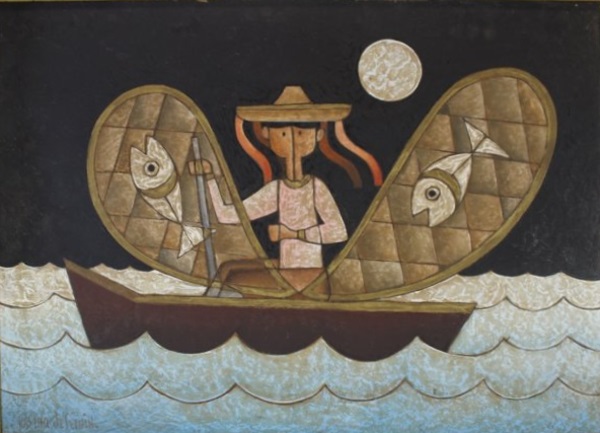
José María de Servin. Date unknown. Fisherman abstract.
In November that year, he exhibited at El Instituto Jalisciense de Cultura Hispánica (Lopez Cotilla #1235) in Guadalajara, and two years after that, in June 1954, he held a solo show at the Instituto Cultural Mexicano-Norteamericano de Jalisco. At about that time, he also attended the opening of a show of works by Don Martin at Casa del Arte.
In 1957 the Centerline (a contemporary general store in Santa Fe, New Mexico) held “an exhibit of immensely lively and decorative watercolors, done on tissue paper, of all things, by Mexican muralist and painter José María de Servín.” The following year, Servín’s paintings were displayed in Harbine Chatfield Inc., an interior decoration store in Cincinnati, Ohio. By then he had also completed murals in Monterrey and at the recently opened Continental Hilton Hotel in Mexico City.
Venues for Servín’s other exhibits during this period included the Galería de Arte Universal in Monterrey (1959); a garden party benefit at a private home in Pasadena, California (1959); the Battle Creek Civic Art Center in Michigan (1962); and the Instituto Cultural Mexicano Norteamericano de Jalisco (Tolsa #300, Guadalajara) in 1964.
Announcing this 1964 solo exhibition, the Guadalajara Reporter referred to him as “the internationally famous Tapatian artist…. Servin’s fame has accumulated through the years and today he stands as one of the most noted artists in Mexico. His flamboyant imagination, graphic presentation and powerful use of color have all contributed to his success as artist and muralist.”
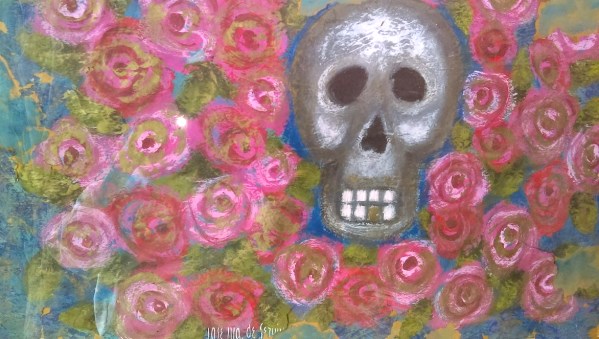
José María de Servin. Date unknown. Reproduced courtesy of Ricardo Santana.
Four years later, after exhibits at the U.de G. Galeria de Artes Plasticas (1965, 1967), Servín showed works in October 1968 at Galeria del Bosque (Calle de la Noche 2677, Guadalajara) in conjunction with the four founder members of Chapala-based Grupo 68: Peter Huf, his wife Eunice (Hunt) Huf, John Kenneth Peterson and Don Shaw. This event was part of the Olympics Cultural Program. Tom Brudenell, who joined the group at about that time, told me that whereas Servin wanted to make a living out of his art, and always showed up formally attired with a jacket and tie, the others (all non-Mexicans) wanted to move art in a new direction and preferred casual clothes.
Toward the end of 1968, the Hufs organized a co-operative gallery in the building known as El Tejaban. The first show in ‘La Galería,’ which opened on Friday 13 December 1968, was a collective titled ‘Life is Art.’ It included works by José María de Servín, as well as works by Tom Brudenell, Alejandro Colunga, John Frost, Paul Hachten, Eunice Hunt, Peter Paul Huf, John Kenneth Peterson, Jack Rutherford, Shaw, Cynthia Siddons (now Cynthia Luria), and Joe Wedgewood.
In 1969, three Grupo 68 artists (the Hufs and Shaw) held a show in Guadalajara at Servín’s gallery Galeria 1728 (Hidalgo #1728). Titled ‘7-7-7’ it featured seven works by each artist; promotional material featured a pose by the three artists emulating the Olympic scoring system.
Servín continued to exhibit regularly into the early 1980s, with shows at Rosenberg’s Gallery, Scottsdale, Arizona (1969); Artesanías Capuchinas, Guadalajara (1971); The Vic Herman Gallery, California, and, from 1981 to 1983 inclusive, alongside Lakeside resident Richard Kitchin, in the annual collective portrait exhibit “El Salón de Retrato” at the Galería Municipal in Guadalajara.
In addition to murals already mentioned, Servín also completed mural works for the Museo Regional, Guadalajara; the Mendoza and Hilton hotels in Guadalajara; Los Arcos de Phoenix, Arizona; and in Tijuana, Baja California.
José María de Servín died in April 1983. Several posthumous exhibitions honoring Servín have been held in Guadalajara since his death, including shows at the Regional Museum (1984, 1985); the Galería Municipal (1985) and the Ex-convento del Carmen (2005).
Sources
- Juan G. Heriberto Allera Mercadillo. 2015. Las villas de descanso de Chapala. Guadalajara: Tecnológico de Monterrey / Municipio de Chapala.
- Battle Creek Enquirer: 19 May 1962, 4.
- El Informador: 22 Aug 1948; 1 Nov 1952, 7; 8 Jul 1965, 8 & 9B; 16 Oct 2005, 8.
- Guadalajara Reporter: 16 July 1964; 26 Oct 1968.
- Santa Barbara News Press: 21 Mar 1971, 56.
- The News Tribune (Dallas, TX): 16 Mar 1952, 58.
- The Los Angeles Times: 24 May 1970, 155.
- The Santa Fe- New Mexican: 16 Jun 1957, 22.
- The Cincinnati Enquirer: 8 Jun 1958, 63.
- The Cincinnati Post: 26 May 1958, 10.
- The Arizona Republic: 23 Mar 1969, 131.
- The San Francisco Examiner: 14 Feb 1943, 25.
Comments, corrections and additional material are welcome, whether via comments or email.

Tony Burton’s books include “Lake Chapala: A Postcard History” (2022), “Foreign Footprints in Ajijic” (2022), “If Walls Could Talk: Chapala’s historic buildings and their former occupants” (2020), (available in translation as “Si Las Paredes Hablaran”), “Mexican Kaleidoscope” (2016), and “Lake Chapala Through the Ages” (2008).